
The AI-Fluent PDLC.

Read this paper if:
- Nearly everyone on your team has an AI subscription
- Cycle times have not reduced and overall productivity gains are elusive
- You'd like a framework on how to move your team to AI fluency
Short on time?
Adoption is not fluency
- Usage up, delivery unchanged
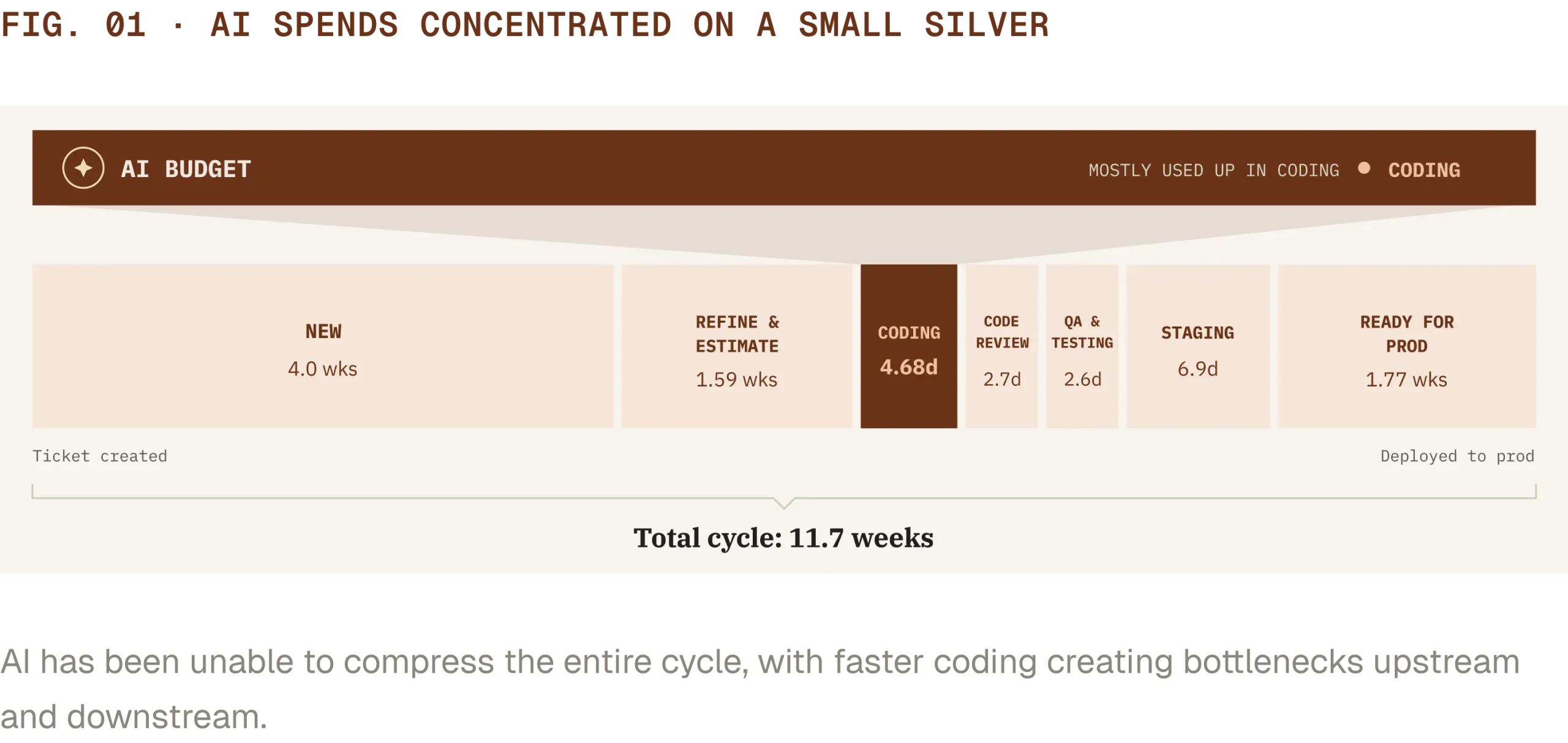
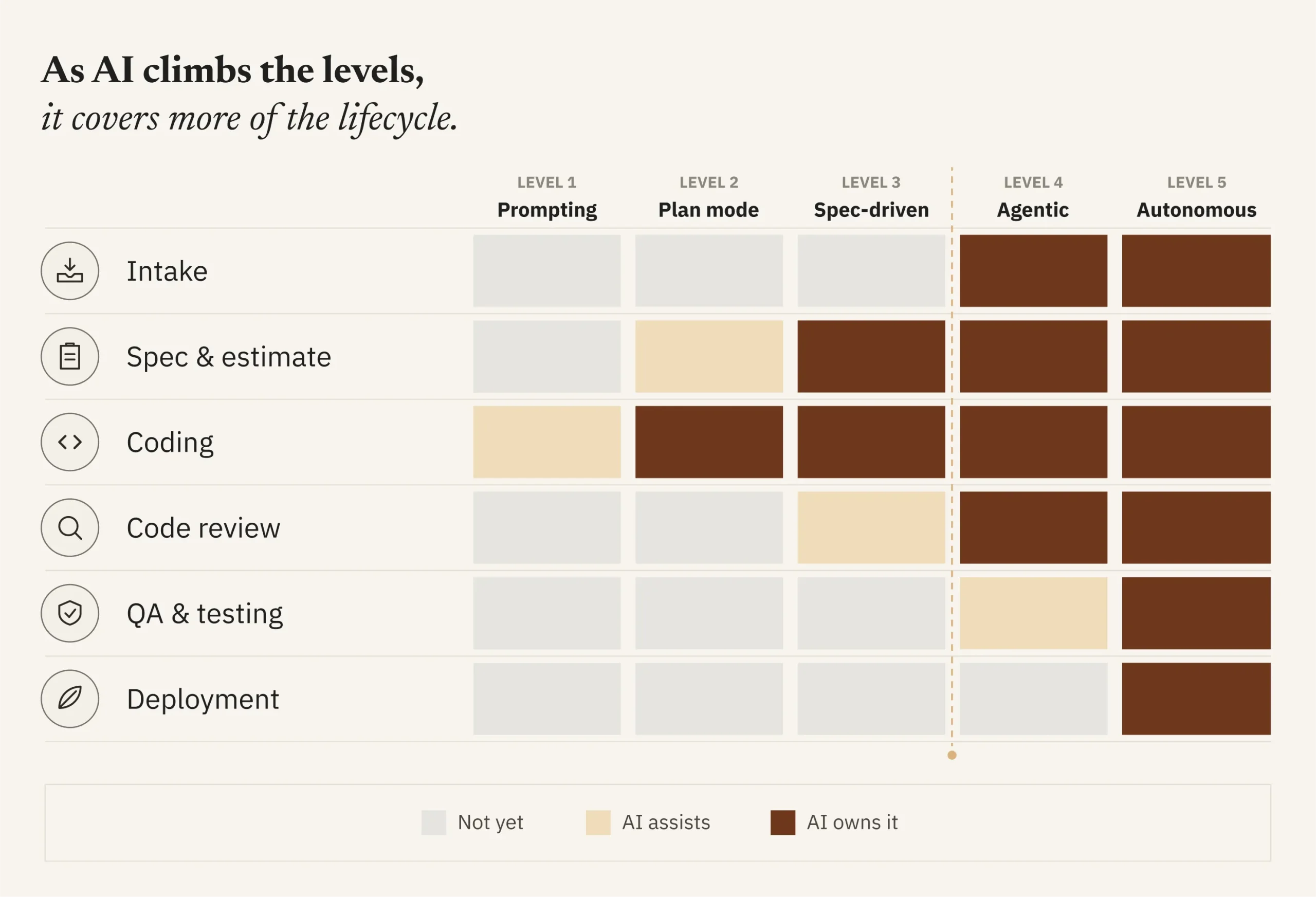
- Coding is not the constraint
- Fluency is speed + trust
90%
7.8%
14%
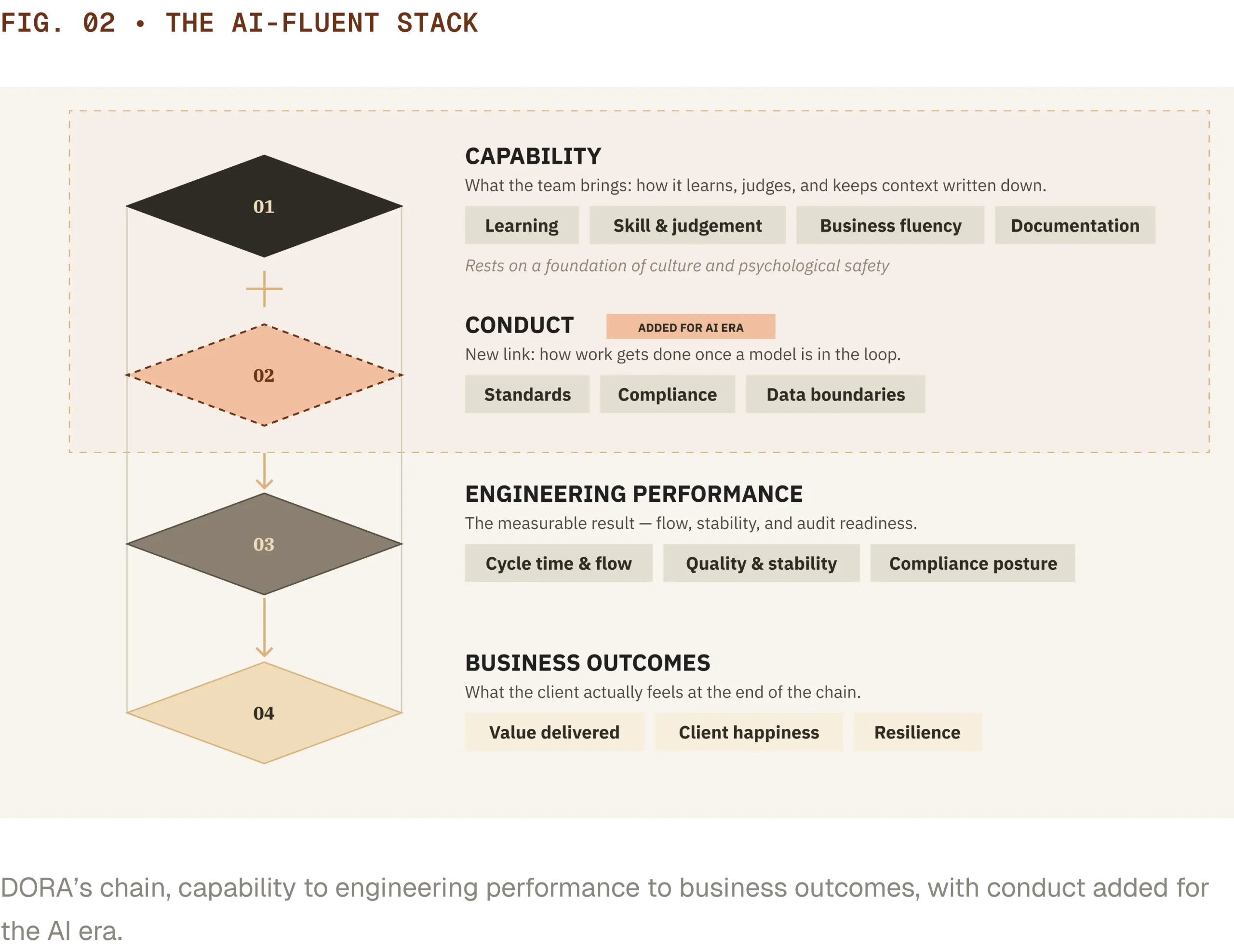
The fluency stack.
CAPABILITY
What your people can do with AI across the whole lifecycle, well beyond the coding stage. Judgment, breadth, business grounding, documented context.
CONDUCT
What your systems hold your people and your agents to while they work. Standards, regulations, and data boundaries, enforced as the code is generated.
The capability layer.
- Learning and continuous improvement
- Skill & judgement
- Business fluency
- Knowledge and documentation systems
Foundation:
Culture decides whether any capability takes root
If it isn’t safe to push back when management demands higher AI usage, your stability numbers will soon be doing that job for you.
DIMENSION 01
Learning and continuous improvement
Learning and continuous improvement
Protected hours for hackathons, learning sessions, and trainings, counted as real capacity on the plan.
Continuous learning carried as an organizational responsibility, with a real budget and cadence behind it.
Interviews that test whether a candidate can read and critique a large AI-generated plan, which now matters as much as writing code from scratch.
Active pairing across product, development and QA, so teams think of business outcomes and not just ticket completion.
DIMENSION 02
Skill and judgement
Skill and judgement
01
Reading and judging AI output
Evaluating large AI-generated plans, diffs, and code for correctness and fit. This is fast becoming the core engineering skill, and what the hiring process should test for.
02
Spec and intent authoring
Telling AI what to build clearly enough to get the right result: specifications, constraints, and acceptance criteria. Drive the transition to spec-driven development to leap past prompt-in, code-out.
03
Architecture and systems judgment
Recognizing good structure when you see it and steering AI toward maintainable design instead of a plausible mess.
04
Generalist breadth
A wide surface area across the stack and the SDLC, so one person can direct AI across more of the work and connect the parts.
05
Craft mindset
Caring enough to ensure that the bar is set high for AI generated code, and quality of the codebase doesn't degrade over time.
DIMENSION 03
Business fluency
Business fluency
66%
75%
~95%
DIMENSION 04
Knowledge and documentation systems
Knowledge and documentation systems
Making the context an agent needs, code, tickets, docs, and design history, reachable at generation time and always updated.
Clean, well-structured internal data amplifies AI success.
With the reasoning behind choices written down, the “why” survives past the person who made the call, and is available to agents as invaluable context.
The practices, patterns, and domain rules your best engineers live by, become reusable skills, commands, hooks, and shared memory that every agentic session inherits.
Modernization is now an AI prerequisite.
The Conduct Layer
The enforcement half of fluency: standards, regulations, and data boundaries held while AI generates code, ensuring manual reviews are not the bottlenecks.
- Coding standards
- Compliance posture
- Data and security boundaries
DIMENSION 01
Coding Standards
01
Session-loaded rules
Standards that load into every AI session automatically and render into each tool’s native format, so they are present as the code is written.
02
Org-wide and repo-specific layers
Clarity around what applies across the company versus to this codebase, so the agent applies the right rules contextually.
03
Craft with AI
Practices like Spec-driven development and working in small batches help you shift left on reviews and keep each unit small enough to reduce cognitive load.
DIMENSION 02
Compliance posture
01
Regulations encoded as guardrails
The frameworks that apply to you, written into rule sets the agent works to as it generates.
02
Audit trails and logging
Logging every prompt, action, and policy decision as the work happens ensures the evidence is always available.
03
DORA's strong version control practices
When every change is small, attributable, and logged with its reasoning, your version history becomes the additional compliance record.
DIMENSION 03
Data and security boundaries
01
In-flight detection
Define what happens when sensitive data is detected before it leaves the network.
02
Tool and action governance
Deliberately define how every tool and MCP call is allowed to do, with destructive operations blocked across the organization.
03
Own the data boundary
Ensure the whole path runs in your VPC or on-prem, so code and data stay inside.
Compliance and audit posture
Engineering performance
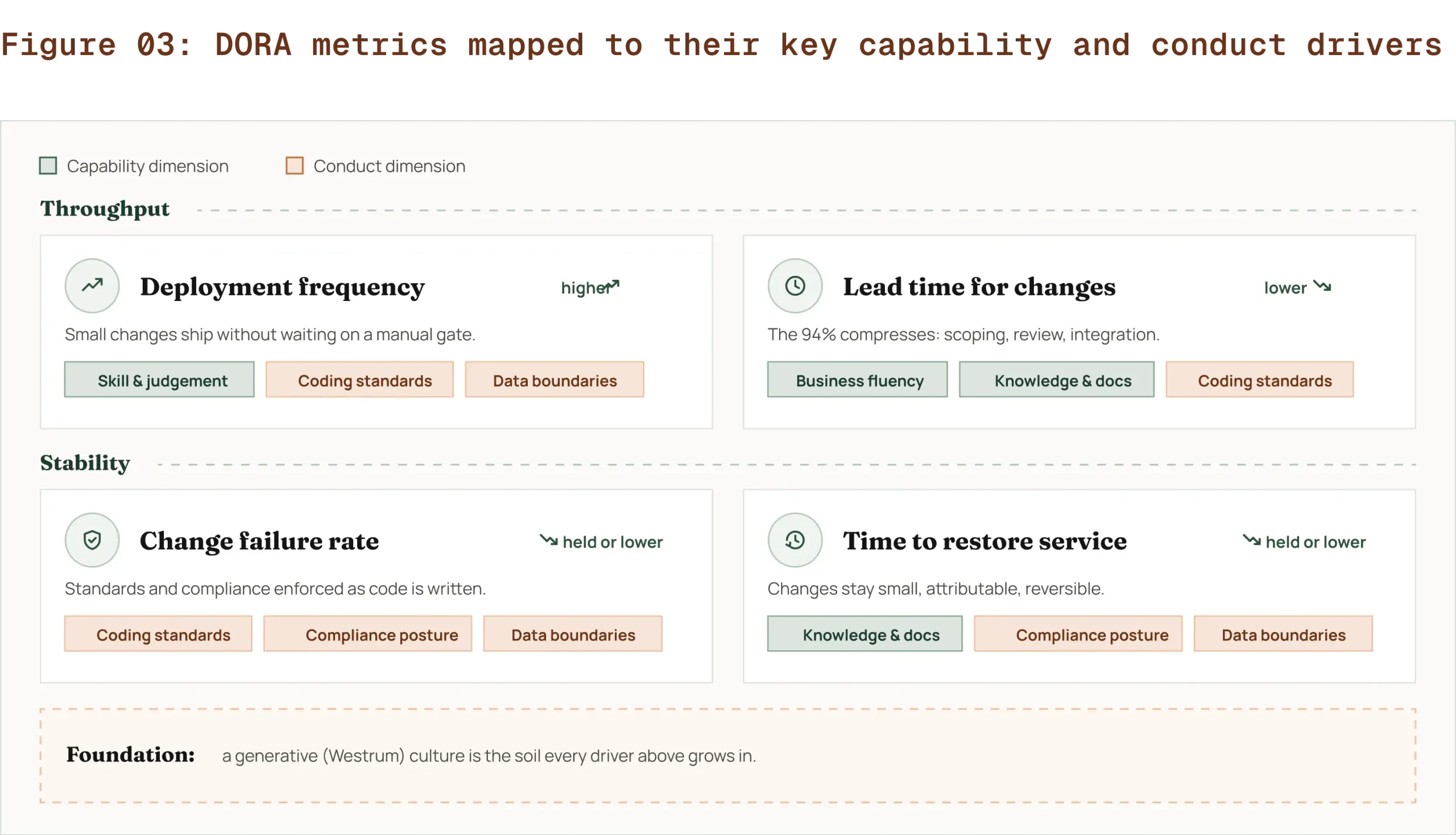
Higher engineering performance is evidence that your capability and conduct layers have been built right.
- Throughput and cycle time
- Stability
- Code quality and technical debt
- Compliance and audit-readiness
01
Throughput and cycle time
The whole cycle compresses, not just the coding sliver.
02
Stability
Change failure rate and time to restore hold as throughput climbs.
03
Code quality and technical debt
The codebase stays ownable months later with sustained developer and agent experience.
04
Compliance and audit-readiness
Compliance posture stays intact with evidence always available.
Reading your fluency
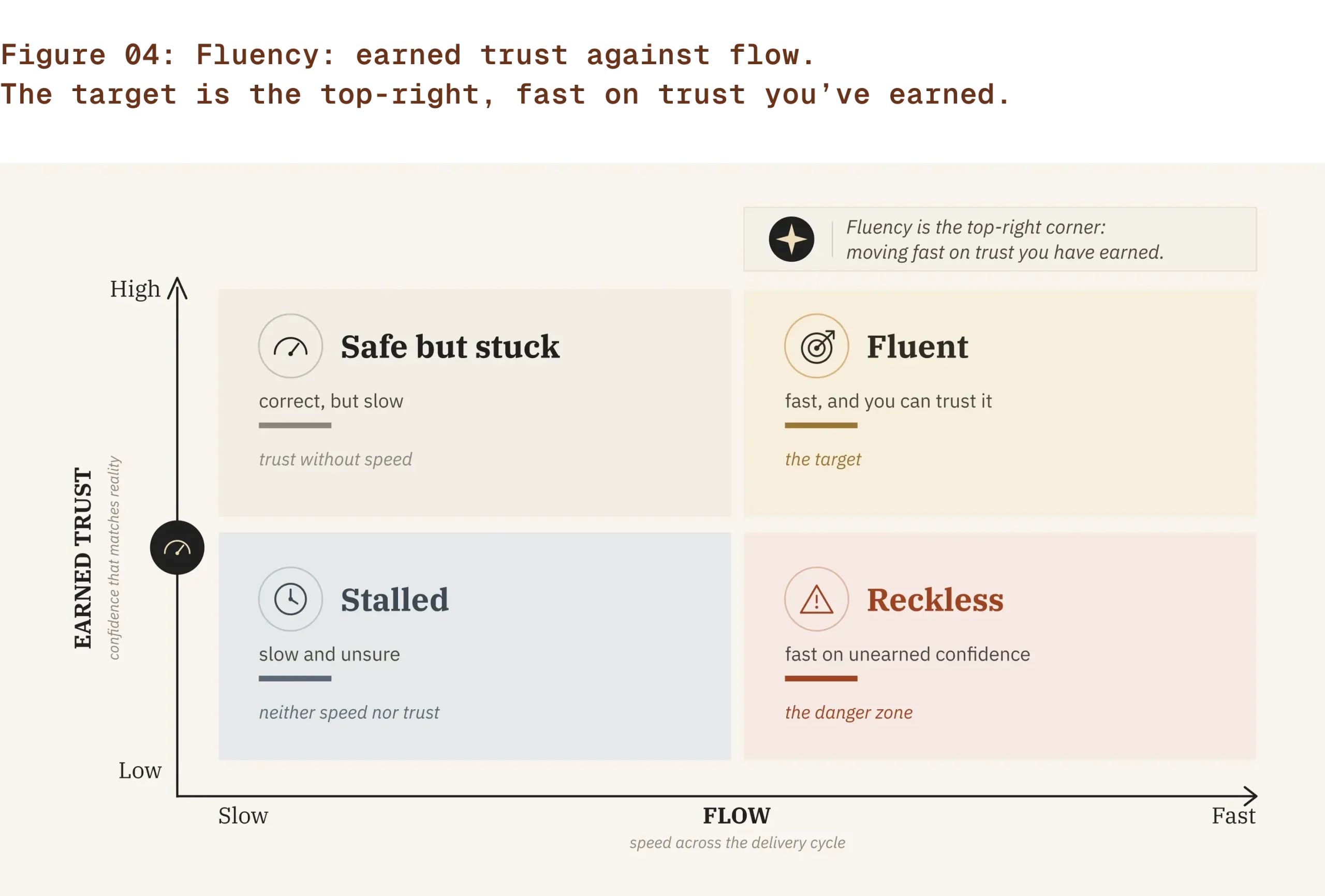
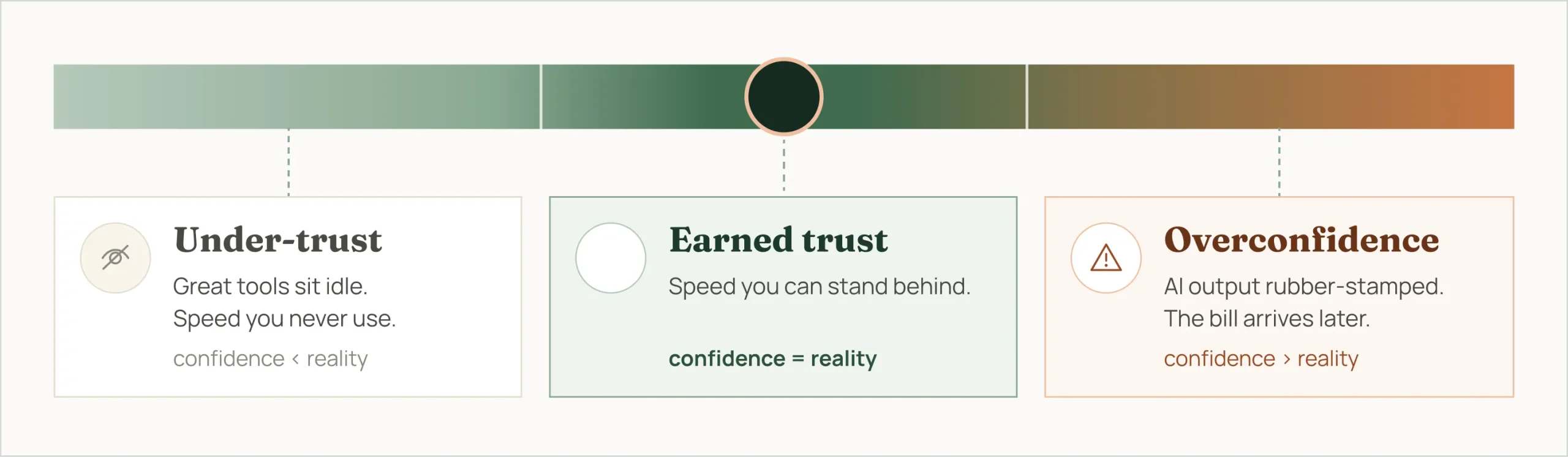
Fluency has two axes: how fast you move across the cycle, and how much of your trust AI has earned.
- Throughput and cycle time
- Stability
- Code quality and technical debt
- Compliance and audit-readiness
A team can feel fluent and yet, not be.
Fluency is fast plus trusted.
Fluent
Fast and trusted at once. Its rare and is the target that this paper is advocating for.
Safe but stuck
Correct and sure of it, but slow. Careful teams live here and mistake it for fluency. The work is to speed up without giving up the feeling of safety.
Reckless
Fast on confidence that hasn’t been verified. It looks like success, while quality degrades quietly. The risk of blowing up anytime makes it the most dangerous corner.
Stalled
Slow and unsure. The pace of work is aligned with low confidence. The work here is to build capability and conduct that improve both, flow and trust.
Flow: the whole cycle moving without friction
Earned Trust: Confidence that matches reality
The 3-point summary
AI Adoption
A large part of the AI budget is currently spent on coding, which is a fraction of the entire delivery cycle. This is why productivity gains are elusive and cycle times are largely unchanged. There are spikes of productivity across the org but these are not predictable and sustained.
Foundations for Fluency
Fluency rests on two organizational layers. Capability - the culture, learning, judgement, and documentation practices that let people direct and check AI across the lifecycle. Conduct, the standards, regulatory rules, and guardrails enforced while AI generates code.
Achieving Fluency
Fluency is when the full delivery cycle is compressed without losing trust in what ships. It can be measured by how much a team trusts the AI-assisted work, along with how much they've been able to reduce their cycle time and enable flow. It can be achieved when organizations build their capability and conduct around AI.
Answer six questions to understand
where your team stands on their journey from adoption to fluency
The offer.
Two ways to install it.
Augment your team's capabilities and introduce the conduct layer, as a product. Fully deployed within your security boundary.
Our forward deployed engineers build your capability and conduct layers for you, alongside your team.
Experience Audit